Clean Up Crew for a 20 Gallon Reef Tank (and 10, 30, 40 and 55)
Quick answer
A good starting clean up crew for a 20 gallon reef is about 8 to 12 snails: 4 astrea snails, 4 cerith snails, 2 nassarius snails and 1 or 2 turbo snails if you have hair algae. Add them once the tank has cycled and starts to show algae, and start with about half of that. Add the rest over the next few weeks only if algae keeps growing.
| Tank | Astrea | Turbo | Cerith | Nassarius | Total |
|---|---|---|---|---|---|
| 10 gallon | 2 | 0 | 2 | 1 | 5 |
| 20 gallon | 4 | 1 or 2 | 4 | 2 | 11 or 12 |
| 30 gallon | 6 | 2 | 6 | 3 | 17 |
| 40 gallon | 8 | 3 | 8 | 4 | 23 |
| 55 gallon | 10 | 4 or 5 | 11 | 5 or 6 | 30 to 32 |
Why fewer snails than the kits suggest
A lot of packaged reef crews are sold at one or two snails per gallon. That is often far more than a young tank can feed. Snails eat what the tank grows. A newly cycled, lightly stocked tank grows only a little algae, and once that is gone, an oversized crew starts to starve. Every snail that dies in a hidden spot adds ammonia, which is the last thing a new reef needs.
Several reef guides land on a much smaller number: roughly one grazing snail per 5 gallons and one nassarius per 10 gallons, as a starting point you adjust to your tank. The counts in the table above follow that rule, with a turbo or two added for tanks that have rock and hair algae.
What each snail does
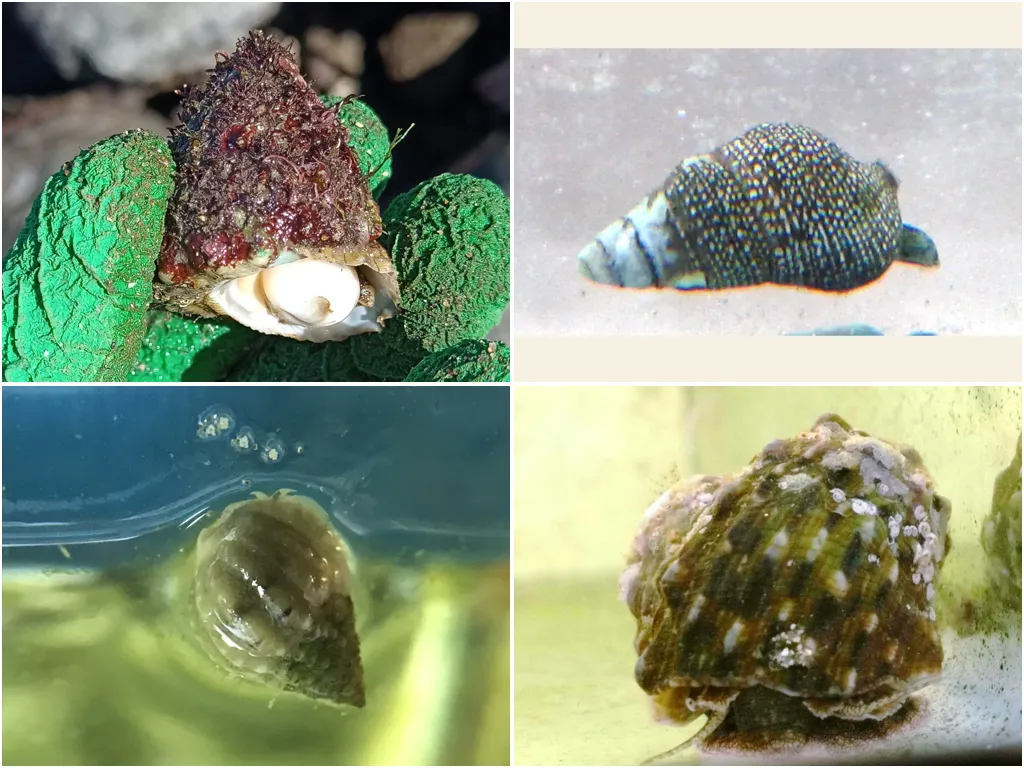
- Astrea snails graze film algae and diatoms on rock and glass. They are small and good for nano and medium tanks. They cannot flip themselves over, so check the sand.
- Turbo snails are big, heavy grazers that eat lots of algae, including hair algae. One or two go a long way. Glue down loose frags.
- Cerith snails graze the sand, rock and glass and turn the top of the sand as they move.
- Nassarius snails stay buried and come out at feeding time to eat leftovers. They do not eat algae, and they need sand.
When to add your crew
Wait until the tank has finished cycling, meaning ammonia and nitrite read zero, and you can see the first brown diatoms or green film. That is food for your crew. Adding snails to a sparkling clean new tank means they arrive with nothing to eat.
A simple plan for a 20 gallon:
- Week 1 after the cycle: add 2 astreas, 2 ceriths and 1 nassarius.
- Weeks 3 to 4: if algae is still showing, add 2 more astreas, 2 more ceriths and 1 more nassarius.
- Later: add a turbo only if hair algae appears and the others cannot keep up.
Matching the crew to your problem
Every tank is a bit different, so adjust the mix:
- Lots of rock, little sand: more astreas and turbos, fewer nassarius.
- Deep sand bed: more ceriths and nassarius.
- Hair algae: 1 or 2 turbos, plus pull long strands by hand and look at what is feeding the algae.
- Heavy feeder with many fish: an extra nassarius or two for leftovers.
Acclimating reef snails
Snails handle a few degrees of temperature change well, but they are sensitive to sudden changes in salinity. Float the bag to match temperature, then add small cups of tank water over 30 to 60 minutes before you move the snails by hand. Do not pour the shipping water into the tank. Set each snail right side up on rock, not on the sand. Our acclimation guide walks through it step by step.
What about hermit crabs?
Many crews include small hermit crabs. They are fun, but they kill snails to take their shells, especially when they outgrow their own. If you keep hermits, add spare empty shells in several sizes. If your crew is all snails, you do not have to worry about it.
Keeping the crew alive
Most losses come from three things: starving in a tank that is too clean, getting stuck upside down, and sudden changes in salinity or temperature. Keep salinity steady around 1.023 to 1.026, top off evaporated water with fresh water, not salt water, and do a quick evening check for flipped snails in the first month. Never dose copper in a tank with snails.
Signs it is time to add more
Watch the tank for two to three weeks after the first snails go in. If film keeps coming back on the glass every day, or the sand turns brown again soon after you see it clean, the crew is not keeping up and you can add a few more grazers. If the glass stays clean and the snails are spread out and slow, the crew is the right size.
Questions
How many snails should a 20 gallon reef have?
About 8 to 12 to start: mostly astreas and ceriths, a couple of nassarius, and a turbo if you have hair algae.
Is one snail per gallon too many?
In most young tanks, yes. One snail per 3 to 5 gallons is a safer start.
Can I add snails before fish?
Yes. Once the tank has cycled and shows algae, snails are a good first addition.
Do I need a clean up crew at all?
You can run a reef without one, but snails save you a lot of glass scraping and help keep the sand bed clean.
What is in your Reef Starter Crew?
6 astrea, 6 cerith, 6 nassarius and 3 turbo snails, 21 in all. That suits a 30 to 55 gallon reef. For a 20 gallon, buy smaller packs of each.
Related guides
Sources
- ReefRig: reef clean up crew starting counts
- Reefstead: reef clean up crew stocking guide
- Practical Fishkeeping: Keeping Turbo and friends
- Reefkeeping.com: The Grazing Snails, Part I (Ronald L. Shimek, Ph.D.)
- Wikipedia: Nassariidae
General hobby guidance. Check your state's rules and never release aquarium animals into the wild.