Turbo Snail vs Astrea Snail: Which Is Better for Your Reef?
Quick answer
Turbo snails are bigger, rounder grazers that eat a lot of algae, including hair algae, so you need only a few. Astrea snails are smaller and cone shaped, fit nano tanks, and are good at film algae on rock and glass. Neither one can reliably flip itself over, so check the sand for upside down snails. A rough start: about 1 turbo per 10 gallons and 1 astrea per 5 gallons in a tank that already grows algae.
| Turbo snail | Astrea snail | |
|---|---|---|
| Shell shape | Rounded, like a turban | Cone or pyramid shaped, often with ridges |
| Size | Larger; some kinds grow past 3 inches | Smaller, a good fit for nano tanks |
| Best at | Heavy grazing, film and hair algae | Film algae and diatoms on rock and glass |
| Underside | Large white operculum (trapdoor) | Smaller operculum |
| Can it flip itself over? | Often not | No, this is its best known weakness |
| Starting count | About 1 per 10 to 11 gallons | About 1 per 5 gallons |
| Good for nano tanks? | Usually too big | Yes |
How to tell them apart
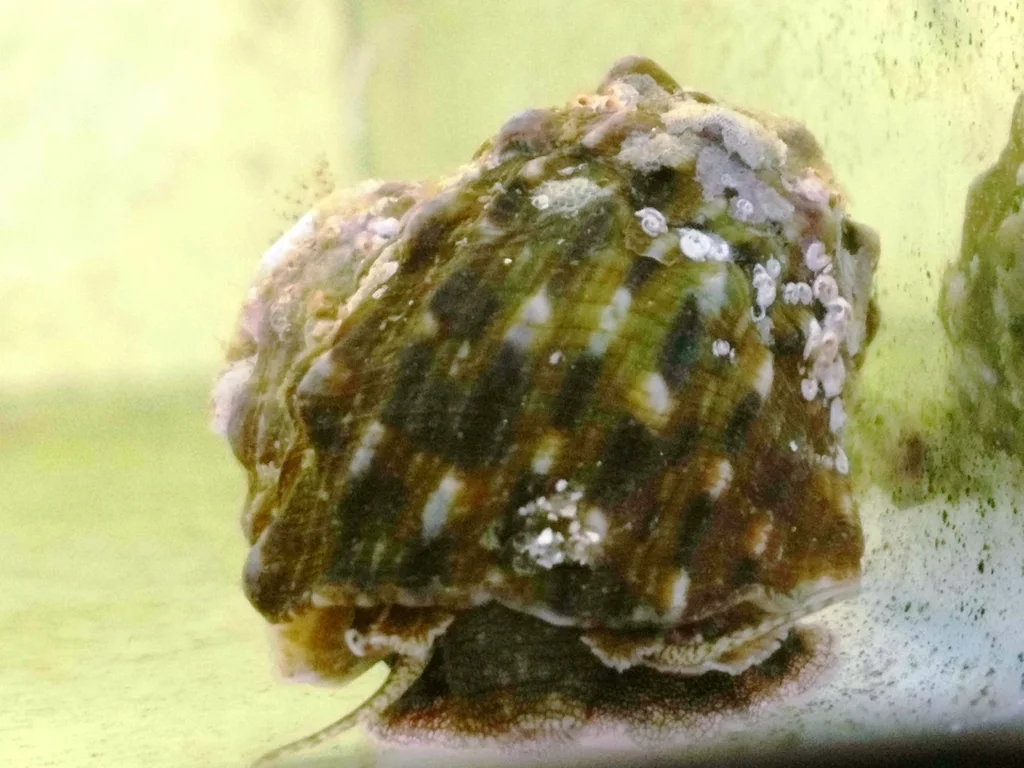
Shimek, a marine biologist who wrote for Reefkeeping magazine, put it simply: an astrea is like an angular turbo. Turbo shells are round and full, like a turban. Astrea shells have flatter sides, so from the side they look like a smooth cone, and many have bumps or ridges that look a bit like a star from above. The name Astraea actually means star.
Flip one over gently and look at the trapdoor, called the operculum. Turbo snails have a large, white, chalky one. That trapdoor is what lets the snail seal itself in when it is disturbed.
Which one eats more algae?
Turbos are the bulldozers of the reef. A single big turbo can clear a surprising amount of rock and glass in a night, and they are known for taking on hair algae as well as film. That appetite is also their limit: a tank needs to grow enough algae to keep them fed, which is why only a few go in each tank.
Astreas eat less each, but they are steady and you can keep more of them. They are good at the thin green and brown film that builds up on rock, and they keep the glass clean too. Because they are small, they reach places a turbo cannot, and they rarely knock anything over.
The upside down problem
Both snails share one weakness: if they fall off the rock or glass and land on their back in the sand, they often cannot turn over. Astreas are the most famous for this. Shimek explains that many astreas come from rocky rubble areas where a falling snail lands in a crack and grabs the rock again, so they never needed a way to flip over. In an aquarium with a flat sand bed, an upside down snail can starve or get eaten by hermit crabs.
The fix is easy: when you see one on its back, turn it over and set it on a rock. Do a quick check each evening during the first few weeks. If the same snails keep falling, look at water quality and food. A weak, hungry snail falls more often.
Warm water and lifespan
Some turbo and astrea snails sold in the hobby come from cooler waters, such as the Gulf of California and Baja. Blue Reef Aquatics notes that keeping cooler water snails in a warm tropical tank for a long time can shorten their life a lot, while tropical snails that are cared for well can live for years. Keep your reef stable, around 72 to 78°F, avoid big temperature swings, and do not expect a snail to live forever in a tank that runs hot in summer.
How many for your tank
Practical Fishkeeping suggests about one turbo per 50 liters (about 11 gallons) and about one astrea per 25 liters (about 5.5 gallons). Those numbers line up with what most reef keepers use as a starting point. Here are simple counts for a tank that has finished cycling and is starting to show algae:
- 20 gallon: 2 turbos or 4 astreas, or 1 turbo plus 2 astreas
- 40 gallon: 3 or 4 turbos plus 4 astreas
- 75 gallon: 6 or 7 turbos plus 6 to 8 astreas
Start with half of that and add more over a month if algae keeps growing. An overstocked crew runs out of food and starts dying, and each dead snail adds ammonia.
Which should you buy?
For a nano reef under 20 gallons, go with astreas. For a larger tank with a lot of rock and a hair algae problem, add a few turbos. For most tanks between 20 and 75 gallons, a mix works best: a couple of turbos for heavy lifting and a group of astreas for steady film control. Then add ceriths and nassarius snails for the sand bed, which neither turbos nor astreas clean.
Before you add them
Glue or wedge down loose frags and rocks. Turbos are big and strong enough to push over coral frags that are not fixed in place. Acclimate slowly. Snails handle temperature well but are sensitive to sudden salinity changes, so match temperature first and then slowly mix in tank water before you move them.
Questions
Are turbo and astrea snails reef safe?
Yes. Both are plant eaters that graze algae and will not eat corals, fish or other invertebrates.
Why is my astrea snail upside down?
Astreas often cannot right themselves on flat sand or glass. Turn it over onto a rock. If many keep falling, test your water and make sure there is algae to eat.
Do turbo snails eat hair algae?
Many keepers use turbos for hair algae. They work best on short, young growth, so pull long strands by hand first.
Can turbo snails knock over corals?
Yes. They are big and strong. Glue frags and stack rock securely.
Do I also need sand snails?
Usually yes. Turbos and astreas graze rock and glass. Cerith and nassarius snails work the sand bed.
Related guides
Sources
- Reefkeeping.com: The Grazing Snails, Part I (Ronald L. Shimek, Ph.D.)
- Practical Fishkeeping: Keeping Turbo and friends
- Blue Reef Aquatics: Turbo and Astraea snails
- AlgaeBarn: All about saltwater snails
General hobby guidance. Check your state's rules and never release aquarium animals into the wild.