Types of Nerite Snails: Olive, Zebra, Tiger, Horned and Virgin Compared
Quick answer
All five popular nerites eat algae, leave healthy plants alone and do not breed in fresh water. The differences are size and look. Horned nerites are the smallest, great for nano tanks and shrimp tanks. Olive nerites are the plain, hardy classic and the best value. Zebra and tiger nerites are larger with bold patterns. Virgin nerites have swirled, one of a kind shells and also do well in brackish water.
| Type | Scientific name | Look | Size | Best for |
|---|---|---|---|---|
| Olive nerite | Neritina sp. | Smooth olive to dark green, fine lines | About 1 inch | Best value, any community tank |
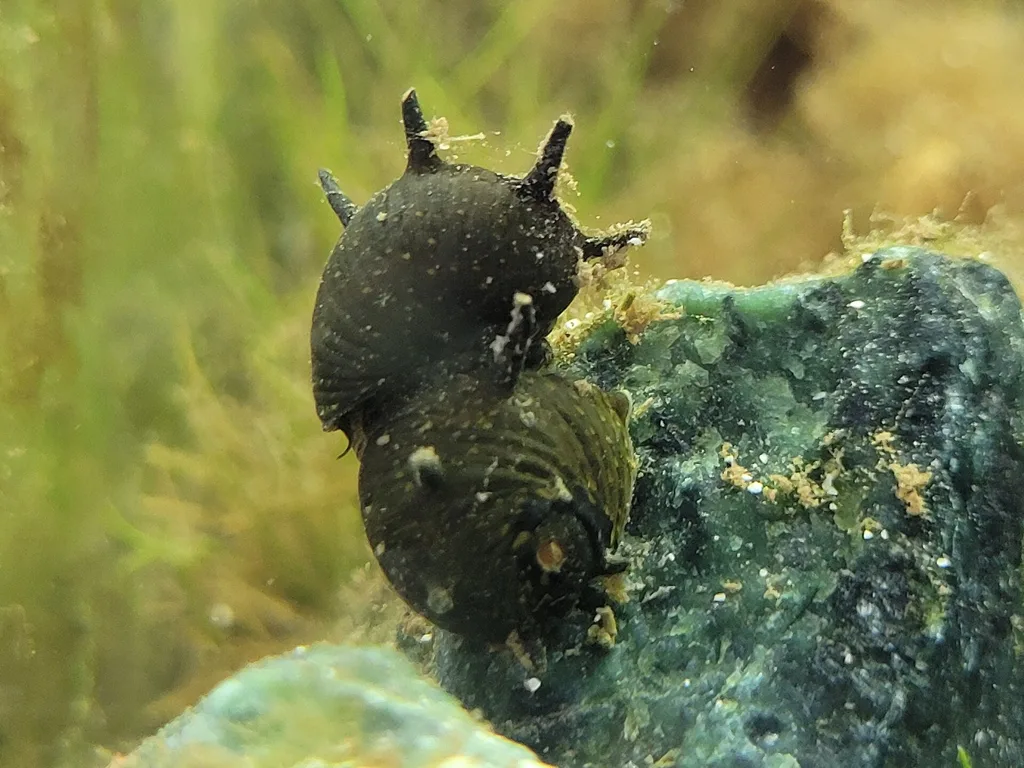
| Horned nerite | Clithon sp. | Small, dark, with spikes on the shell | About half an inch | Nano tanks, shrimp tanks, tight spots |
| Zebra nerite | Neritina natalensis | Black and gold stripes | Up to about 1 inch | Glass and rock in medium tanks |
| Tiger nerite | Neritina sp. | Amber with dark tiger marks | Up to about 1 inch | Show tanks and planted tanks |
| Virgin nerite | Neritina virginea | Swirls of black, red and cream; each one different | About half an inch to 1 inch | Collectors, brackish tanks |
What every nerite has in common
Nerites belong to the family Neritidae. The ones sold for aquariums share the traits that made them popular: they graze film algae, green spot algae and diatoms on glass, rock, wood and leaves; they leave healthy plants alone; and their eggs do not hatch in fresh water, because the young need brackish or salt water to develop. They all want stable, cycled water around 72 to 80°F, a pH of 7 or higher, and a lid, because they like to climb.
So the choice is mostly about size, looks and what your tank needs.
Olive nerite: the workhorse
The olive nerite is the most common and least expensive nerite. Its shell is smooth and glossy, olive green to dark brown, with fine wavy lines. It is tough, it eats a lot, and it is long lived: a biologist who kept wild olive nerites in his tanks reported some living more than six years, and found that about six adults kept a 20 gallon tank free of algae. If you just want clean glass for the least money, start here.
Horned nerite: small and spiky
Horned nerites are the smallest of the group, about half an inch, with little spikes on the shell. Their size lets them work between plants, in the corners and on the narrow parts of hardscape. They are a natural pick for nano tanks of 3 to 10 gallons and for shrimp tanks, where a big snail would be out of scale. Their spikes can poke soft fingers when you handle them, but they do not hurt fish or shrimp.
Zebra nerite: bold stripes
Zebra nerites have sharp black and gold stripes that run around the shell. They are a little larger than horned nerites and have a big appetite for film algae on glass and rock. They are a popular pick for a 10 to 40 gallon tank where you want the snail to be noticed. Like all nerites, they sometimes try to leave the tank in their first week, so keep the lid on.
Tiger nerite: warm colors
Tiger nerites have an amber or orange shell with dark, jagged marks that look like tiger stripes. They are similar in size and habits to zebra nerites, and they stand out against green plants. Many planted tank keepers choose them for that reason. The pattern varies a lot from snail to snail.
Virgin nerite: one of a kind shells
Virgin nerites (Neritina virginea) are small and come in an amazing range of patterns: black and white lines, red bands, cream swirls and dots. No two look alike, which makes them fun to collect. In the wild they live in coastal waters of the Americas, and in tanks they do well in both fresh and brackish water.
Mixing types in one tank
Nerites of different kinds get along fine together, and a mixed group looks great. A simple plan for a 20 gallon planted tank is 2 olive nerites for heavy grazing plus 2 zebra, tiger or virgin nerites for color. For a 5 gallon shrimp tank, 1 or 2 horned nerites is plenty. Add more only if algae keeps coming back after a few weeks, and feed an algae wafer if the tank gets so clean that the snails run out of food.
Feeding any nerite
Nerites live mostly on the algae and film your tank grows. In a planted tank with good light there is usually enough. In a very clean tank, add an algae wafer or a slice of blanched zucchini once or twice a week, and remove what is left the next day. Calcium in the water, from crushed coral or a cuttlebone, keeps their shells strong.
Questions
Which nerite eats the most algae?
Larger nerites like olive, zebra and tiger eat more per snail. Horned nerites eat less but reach tighter spots.
Which nerite is best for a shrimp tank?
Horned nerites. They are small and peaceful and do not compete with shrimp for much food.
Do any nerites breed in fresh water?
Not the ones sold for aquariums. Their young need brackish or salt water.
Why is my nerite not moving?
Nerites often rest for a day or two, especially after shipping. Check that the trapdoor is closed and there is no bad smell.
Can nerites live in saltwater?
Some, like virgin and olive nerites, handle brackish water well. Most aquarium nerites are kept in fresh or brackish water, not full reef tanks.
Related guides
Sources
- Wikipedia: Neritidae
- NANFA American Currents: The Perfect Marine Snail for Your Freshwater Aquarium (Chris Barnhart, Missouri State University)
- Aquatic Arts: Will nerite snails reproduce in a freshwater aquarium?
- Revue d'Ecologie: Freshwater neritids of tropical islands, amphidromy as a life cycle
General hobby guidance. Check your state's rules and never release aquarium animals into the wild.