Do Nerite Snails Lay Eggs in Freshwater? (And Will They Hatch?)
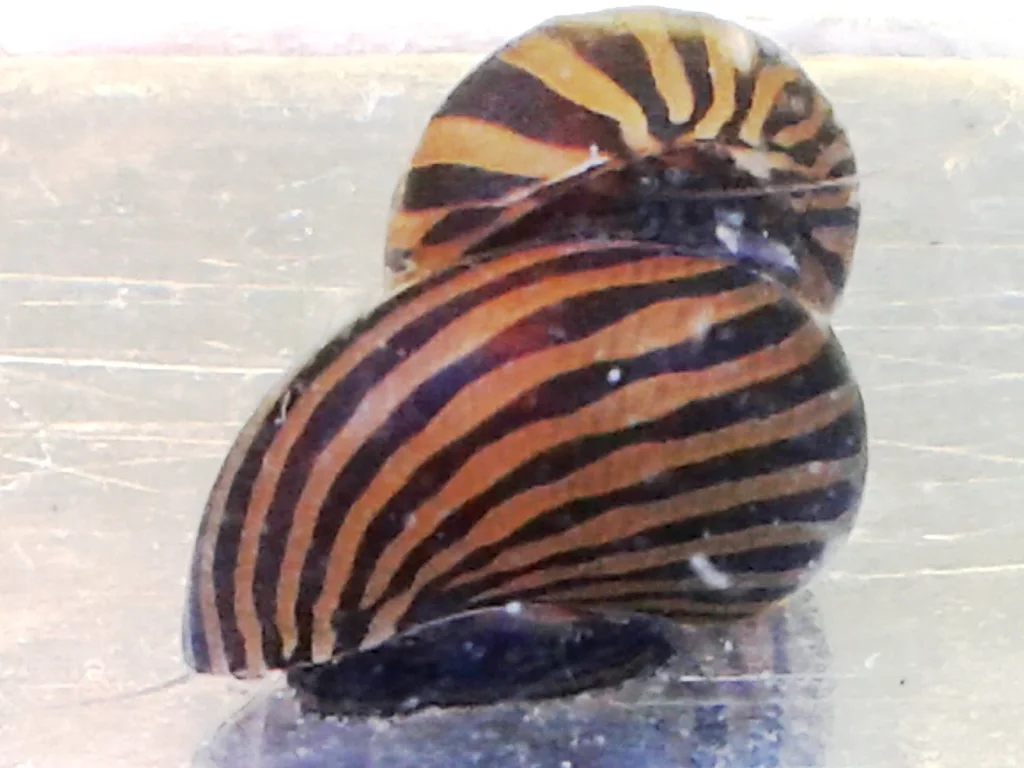
Quick answer
Yes. Female nerite snails often lay small white egg capsules on wood, rock, glass and equipment in freshwater tanks. No, they will not hatch into baby snails there. The young drift to the sea in the wild and need brackish or salt water to grow, so a normal freshwater tank never gets a nerite population. The capsules are harmless and can be scraped off with a razor blade or plastic card.
| What you see | Likely from | Will it hatch in fresh water? |
|---|---|---|
| Hard white dots, about 1 to 3 mm, one by one on wood, rock or glass | Nerite snail | No |
| Pink or peach clutch stuck above the waterline | Mystery snail | Yes, in 2 to 4 weeks |
| Clear jelly blob with tiny dots, under the water | Pond or bladder snail (pest snails) | Yes |
| Flat jelly disc on glass or leaves | Ramshorn snail | Yes |
| No eggs, but live baby snails appear | Rabbit snail (gives birth to live young), or a pest snail | Already hatched |
What those white dots are
If you have nerites, sooner or later you will see small white or cream ovals stuck to driftwood, rocks, the glass or a heater. Each one is an egg capsule. Scientists who study nerites describe them as flat, oval capsules, about 1 to 3 mm long, laid on hard surfaces and covered with fine grains. A fresh capsule is white and turns cream or brown over a few days. One capsule can hold many tiny eggs.
Females store sperm from males, so a nerite that mated before it reached you can keep laying for a long time, even if it is the only nerite in your tank.
Why they never hatch in fresh water
Many nerites live an unusual life in the wild. The adults live and lay eggs in rivers and streams. When the eggs hatch, the tiny larvae drift down to the sea, where they need salt water to grow. Later, the young snails climb back up the river. Scientists call this an amphidromous life cycle.
A freshwater aquarium has no sea for the larvae to reach, so the cycle stops. The eggs may hatch into larvae that cannot survive, or they may not develop at all. Either way, you will not end up with baby nerites. This is the main reason nerites are the favorite algae snail for people who do not want a snail boom.
If you see lots of tiny snails in a nerite tank, they are not nerites. They are usually pest snails, such as bladder or pond snails, that came in on plants.
Can you breed them on purpose?
It is possible, but it is hard and needs a separate setup. Breeders move the eggs or larvae into brackish or salt water and feed the larvae tiny algae. It is a project for experienced keepers, not something that happens by accident.
How to remove the eggs
- Glass: use a razor blade scraper or an old gift card. Hold it at a low angle and push.
- Rocks and wood: take them out during a water change and scrub with a stiff brush. Some keepers use a toothbrush.
- Plants: nerites rarely lay on leaves. If they do, trim that leaf.
- Leave the rest: the capsules do no harm. Over weeks they often fade or get grazed by other animals.
How to get fewer eggs
You cannot stop a female from laying, but you can cut down the mess:
- Keep fewer nerites. About 1 per 5 gallons is plenty for most tanks.
- Choose your hardscape with this in mind. Nerites tend to lay on dark, hard surfaces like wood and stone. A smooth tank wall is easier to scrape than rough rock.
- Horned nerites and other small kinds leave smaller capsules that are less noticeable.
Is laying eggs a good sign?
Usually, yes. A snail that is laying is eating well and is not stressed. Egg laying often picks up when the snail has plenty of algae and stable water. If your nerite was laying and suddenly stops, look at food and water quality.
Nerite eggs in brackish tanks
Some nerites, such as virgin nerites and the olive nerites of the US Gulf Coast, also live well in brackish water. A biologist who kept olive nerites noted that they tolerate a wide range of salt, from fresh water to more than seawater. In a true brackish or saltwater tank, it is possible that some young survive. In a normal freshwater community tank, they will not.
Eggs on plants and equipment
Nerites mostly lay on hard surfaces, but they also use filter intakes, heaters and the rims of decorations. These are easy to clean during a water change. Unplug the heater first and let it cool before you scrub it. A soft brush is enough for plastic parts.
Questions
Do I need a male and a female for nerite eggs?
A female needs to have mated at some point, but she can store sperm and keep laying for a long time without a male in the tank.
Are nerite eggs bad for shrimp or fish?
No. They are harmless.
Do nerite eggs ever go away on their own?
Many fade over time, but some stay for months. Scraping is the fastest fix.
Which nerite lays the most eggs?
It varies by snail more than by kind. Any female nerite can lay a lot when she is well fed.
Will adding aquarium salt make the eggs hatch?
No. A normal dose of aquarium salt is far below what the larvae need.
Related guides
Sources
- Revue d'Ecologie: Freshwater neritids of tropical islands, amphidromy as a life cycle
- Aquatic Arts: Will nerite snails reproduce in a freshwater aquarium?
- NANFA American Currents: The Perfect Marine Snail for Your Freshwater Aquarium (Chris Barnhart, Missouri State University)
- Wikipedia: Neritidae
General hobby guidance. Check your state's rules and never release aquarium animals into the wild.