Mystery Snail vs Nerite Snail: Which One Should You Get?
Quick answer
Pick nerite snails if your main goal is algae on glass, rocks and leaves. They are small, they leave healthy plants alone, and their eggs do not hatch in fresh water. Pick mystery snails if you want a big, active snail that cleans up leftover food and soft algae and is fun to watch. In a tank of 20 gallons or more, many keepers use both: nerites for algae and one or two mystery snails for leftovers.
| Mystery snail | Nerite snail | |
|---|---|---|
| Scientific name | Pomacea diffusa | Family Neritidae (Neritina, Clithon and others) |
| Adult size | About 2 inches | About 0.5 to 1 inch |
| Best at | Leftover food, soft algae, dying leaves | Film algae, green spot algae, diatoms |
| Eggs in fresh water | Pink clutch above the waterline, will hatch | Small white capsules, will not hatch |
| Breeding | Separate sexes, needs a male and a female | Larvae need brackish or salt water |
| Temperature | 68 to 82°F | 72 to 80°F |
| Smallest tank we suggest | 5 gallons | 5 gallons (3 for horned nerites) |
| Can we ship to every state? | No: not to AZ, ME or GA | Yes |
The short version
Both snails are peaceful, both are easy, and both eat algae. The difference is what kind of mess each one handles best. A nerite is a small, steady grazer. It rasps the thin film of algae off every hard surface and keeps going day and night. A mystery snail is a big, busy scavenger. It roams the tank, finds the fish food that fell behind a rock, chews on leaves that are already dying, and grazes soft algae along the way.
If you can only buy one snail and algae is the problem you are trying to fix, choose a nerite. If your tank is fairly clean and you want a snail with personality, choose a mystery snail. If you have the room, keep both. They do not compete much, and they share the same water needs.
Algae eating: nerites win
Nerites are the snail most keepers reach for when green spot algae, brown diatoms or a green film show up on the glass. A biology professor who kept olive nerites in a stream tank for years found that about half a dozen adults kept a 20 gallon tank free of algae, including tough blue green mats. That is a strong result for such a small animal.
Mystery snails do eat algae, but it is not their main job. They prefer softer foods: biofilm, leftovers, sinking pellets and soft or decaying plant tissue. Algae alone will not keep a mystery snail fed, so plan on feeding it a few times a week. A nerite, on the other hand, can live mostly on what the tank grows, as long as there is visible algae. In a very clean tank, add an algae wafer for either snail.
Size and how they look
A grown mystery snail is about the size of a golf ball, and it comes in gold, blue, ivory, purple and other colors. It has long feelers and a breathing tube, called a siphon, that it stretches up to the surface. That size makes it easy to see from across the room, and it is one reason people get attached to them.
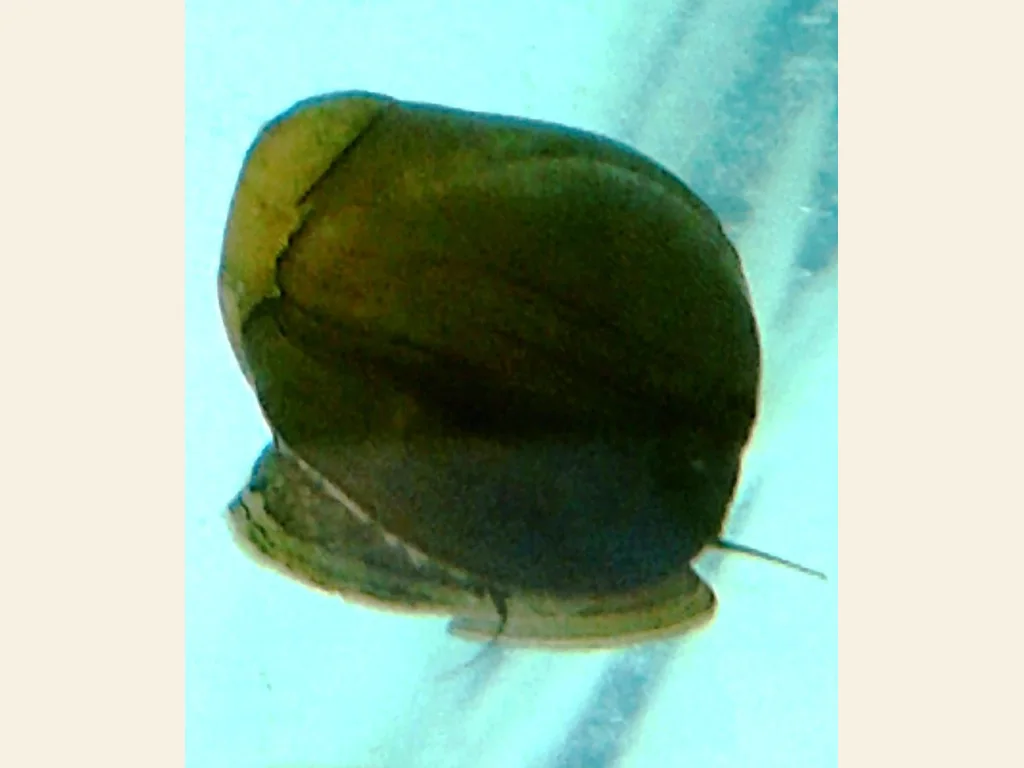
Nerites stay small, about half an inch to an inch. What they lack in size they make up for in patterns: smooth olive shells, black and gold zebra stripes, amber tiger marks, spiky horned shells and the swirled colors of virgin nerites. Because they are small, they fit into nano tanks and get into tight corners a mystery snail cannot reach.
Eggs and babies: the big difference
This is the point most people care about. Nerites do lay eggs in fresh water. Females leave small white capsules, about the size of a sesame seed, on wood, rock and glass. But the young need brackish or salt water to grow, so the eggs do not turn into baby snails in a normal freshwater tank. You get no population boom, only some white dots that are hard to scrape off.
Mystery snails are different. They have separate sexes, and a female lays a pink clutch above the waterline, often under the lid. Those eggs can hatch in two to four weeks. The good news is that the clutch is easy to see and easy to remove. If you do not want babies, lift it off and throw it away. If you keep only one mystery snail, it may still lay eggs if it is a female that mated before you got it, so keep an eye on the area above the water.
Water and tank setup
The two snails want very similar water. Both like water that is neutral to slightly alkaline, with enough minerals to build a strong shell. Soft, acidic water slowly eats away at shells, so many keepers add crushed coral or a piece of cuttlebone. Both are sensitive to copper, which is in some fish medicines, so never treat a snail tank with copper.
Both also climb. Nerites are famous for crawling out in their first days, and mystery snails need an inch or two of air between the water and the lid to breathe and lay eggs. A lid solves both problems. Add snails only to a cycled tank. Like any animal, they are hurt by ammonia and nitrite.
Using both in one tank
In a 20 to 30 gallon community tank, a good mix is about 4 to 6 nerites and 1 to 3 mystery snails. The nerites work the glass, rocks and plant leaves. The mystery snails work the floor and finish the food your fish miss. Start on the low end and add more only if algae keeps coming back after a few weeks. Too many snails in a clean tank go hungry.
This exact pairing is what our Freshwater Starter Crew is built around: 6 olive nerites plus 3 mystery snails. If you live in Arizona, Maine or Georgia, choose nerites only, because those states restrict mystery snails and we do not ship them there.
Tank mates to avoid
Neither snail is safe with fish that eat snails. Puffers, most loaches and crayfish will pick at or kill them. Large cichlids can bother mystery snails, which are slow and easy to grab by the feelers. Shrimp, tetras, rasboras, guppies, corydoras and most peaceful community fish are fine with both.
Questions
Can mystery snails and nerite snails live together?
Yes. They want the same water, they are both peaceful, and they eat slightly different things, so they get along well.
Which snail is better for a 5 or 10 gallon tank?
Nerites. They are small and add less waste. A single mystery snail can live in a 5 gallon, but a 10 gallon gives it more room.
Will nerite eggs hatch if I add a little salt?
Not in a normal freshwater tank. The young need true brackish or salt water to develop, so a pinch of aquarium salt does not change that.
Do mystery snails eat plants?
Healthy, well fed mystery snails mostly eat soft or dying leaves. If they are hungry they may nibble soft plants, so feed them a few times a week.
Which one lives longer?
Mystery snails usually live about one to two years. Nerites often live longer, and one researcher kept wild olive nerites alive for more than six years.
Related guides
Sources
- Applesnail.net: Pomacea diffusa
- Animal Diversity Web: Pomacea
- NANFA American Currents: The Perfect Marine Snail for Your Freshwater Aquarium (Chris Barnhart, Missouri State University)
- Aquatic Arts: Will nerite snails reproduce in a freshwater aquarium?
- USDA APHIS: apple snail permits
General hobby guidance. Check your state's rules and never release aquarium animals into the wild.